
The South African Rooibos Council (SARC) announced on 2 November 2026 that the project had reached another important stage, following a farewell event hosted by Allison Areias, United States Consul General in Cape Town. The seeds will travel alongside South African school and university science experiments as preparations continue for their journey into space.
The initiative highlights an unusual intersection between agriculture, scientific research, education and technological innovation, while placing one of South Africa’s most recognisable indigenous agricultural products at the centre of an international research project.
Taking an indigenous South African plant into space
Rooibos, scientifically known as Aspalathus linearis, is indigenous to the Cederberg region of the Western Cape. The plant has become an important part of South Africa’s agricultural identity, supporting farming communities, processing businesses and international exports.
The Rooibos in Space project seeks to investigate how the plant’s seeds respond to environmental conditions beyond Earth. In particular, researchers will examine the effects of microgravity and space radiation on the seeds before they return to South Africa for further testing.
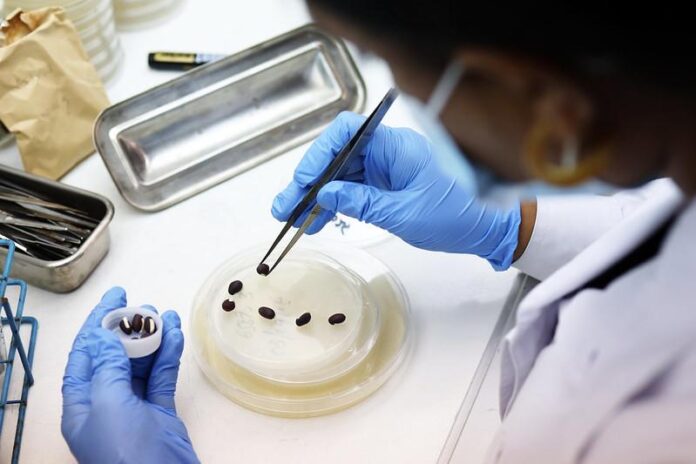
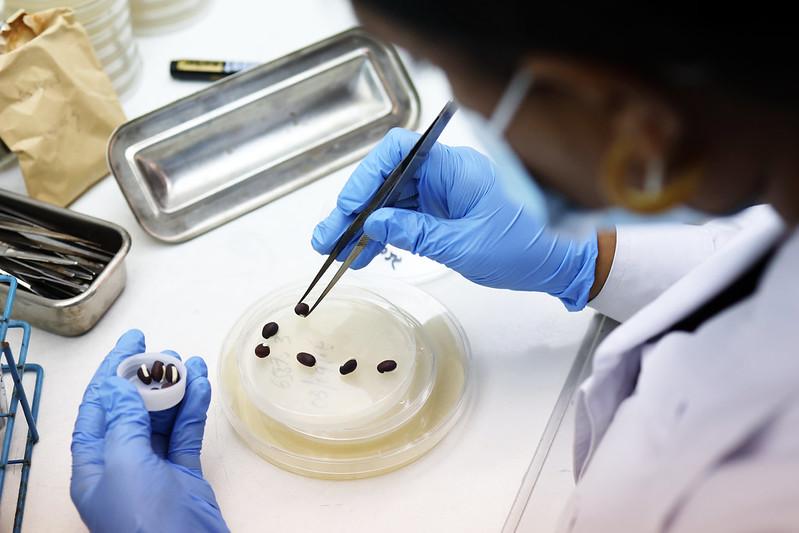
According to the South African Rooibos Council, the project involves 17,346 seeds weighing approximately 74.2 grams. The seeds will be transported to the United States before being prepared for their scheduled spaceflight.
The experiment is expected to take place aboard the International Space Station, where the seeds will be exposed to conditions that differ significantly from the natural environment in which Rooibos grows.
This research could provide valuable scientific observations about seed behaviour, germination and plant development following exposure to space conditions.
Three seed treatments will be tested
An important part of the experiment involves comparing different seed preparation methods.
The Rooibos seeds have been divided into three groups to help researchers evaluate whether preparation techniques influence their response to space exposure.
These include untreated seeds, scarified seeds and seeds that have undergone scarification followed by treatment with a protective agricultural coating.
Scarification is a process that weakens or breaks the outer seed coat, helping water enter the seed and potentially supporting germination.
By comparing the three groups after their return to Earth, researchers will be able to examine whether the different treatments produce variations in germination and subsequent plant development.
The experiment will be housed in a specialised Nanolab, a compact laboratory module designed to accommodate research activities in space.
The project is scheduled to travel to the ISS aboard the Cygnus NG-25 commercial resupply spacecraft. The launch is currently expected between December 2026 and January 2027, following adjustments to the flight schedule.
The seeds are expected to spend approximately four to six weeks in space before returning to Earth.
From space research to South African classrooms
Beyond its scientific objectives, the project also aims to introduce young South Africans to practical science, technology, engineering and mathematics (STEM) education.
Once the seeds return, participating schools and researchers will conduct further investigations by planting the space-exposed seeds alongside control seeds that remained on Earth.
Schools in the Cederberg region, which is closely associated with Rooibos production, and Parklands College will participate in the educational programme.
Over approximately 18 months, learners and researchers will monitor germination, growth patterns and plant development.
The comparison will help establish whether exposure to microgravity and space radiation has influenced the seeds’ behaviour.
This approach provides learners with an opportunity to participate in a real scientific experiment rather than simply studying space research through textbooks.
The initiative also demonstrates how agricultural research can support education by connecting familiar local crops with broader scientific questions.
Collaboration brings agriculture and space science together
The Rooibos in Space initiative was conceived by the South African Rooibos Council and developed in collaboration with MaxIQ Space.
The partnership brings together agricultural knowledge, seed preparation expertise, educational participation and space research capabilities.
For the Rooibos industry, the project represents an opportunity to explore new scientific questions about an indigenous plant while increasing awareness of South Africa’s agricultural contribution to research and innovation.
Cyril Ngqwala, a Rooibos seed technician involved in preparing the experiment, described the process as an opportunity to combine practical knowledge of Rooibos seeds with advanced scientific research.
The project also highlights the importance of collaboration between agricultural organisations, researchers, educational institutions and technology partners in developing new knowledge.
What this means for South African agriculture
Agriculture increasingly depends on research and innovation to address challenges involving crop productivity, environmental conditions, seed quality and long-term sustainability.
Although the Rooibos space experiment is not designed to deliver immediate commercial farming solutions, its findings could contribute to a better understanding of how seeds respond to unusual environmental conditions.
The research may also strengthen interest in agricultural biotechnology and encourage more young people to consider careers in agricultural science, plant research and related technology fields.
For South Africa, the project provides an opportunity to showcase an indigenous agricultural product through an international scientific platform.
It also reinforces the importance of protecting and investing in agricultural knowledge that originates from the country’s unique natural resources.
As preparations continue towards the planned launch, attention will turn to the eventual return of the seeds and the research findings that follow.
The real scientific value will emerge through the comparison of the returned seeds with those that remain on Earth. Their growth and development could provide new insights into the behaviour of Rooibos under unusual environmental conditions.
For a plant deeply rooted in South African soil, the journey to space represents an exciting new chapter in the country’s agricultural and scientific story.
Read More: https://sarooibos.co.za/