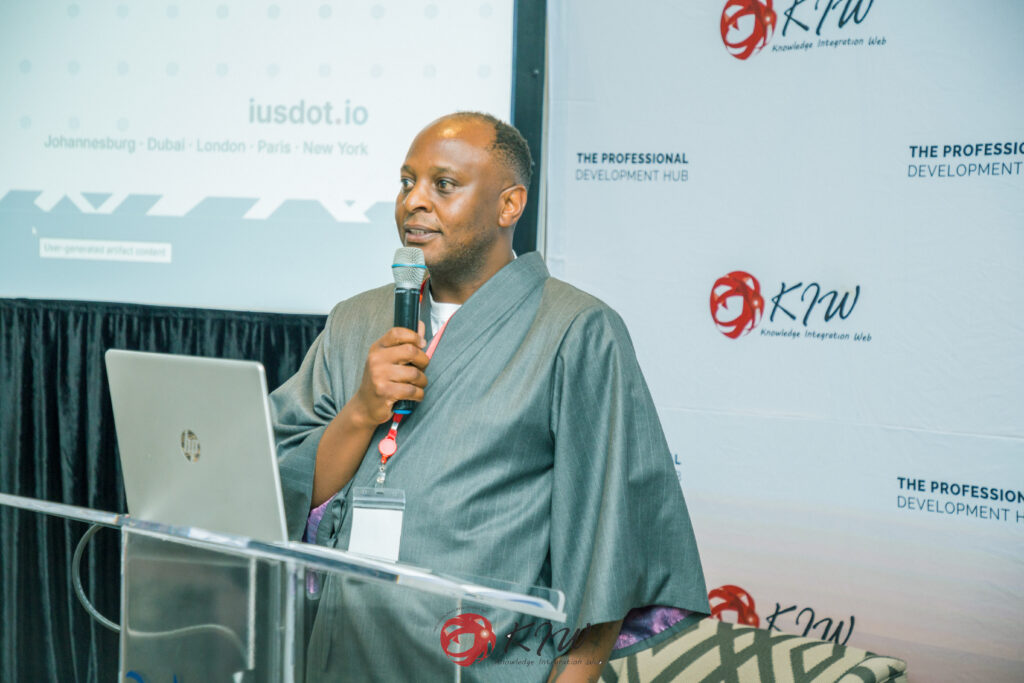
For many South African organisations, compliance still arrives too late. Registers are compiled at year-end, audit packs are assembled under pressure, and governance committees review risks that materialised months earlier. At the Big Data and Business Analytics Conference 2026, held on 28 and 29 October at the Radisson Blu Gautrain Hotel in Sandton, event partner ius. presented a different model, one in which compliance is embedded in the work as it happens rather than reported after the fact.
Delivering the Day One keynote, Unifying People, Projects and Compliance: Leveraging Data for Enhanced Compliance and Governance Outcomes, Reitumetse Benedict Phiri, Group CEO of ius.group, addressed a challenge familiar to every executive in the room. Organisations hold vast quantities of data about their employees, clients, projects and suppliers, yet that information typically sits in separate systems owned by separate departments. Human resources maintains one record, operations another, procurement a third, and the compliance function is left to stitch the picture together manually when a regulator, auditor or board asks a question.
The Cost of Fragmented Data
Phiri argued that fragmentation is not merely an efficiency problem; it is a governance risk. When people data is disconnected from project data, an organisation cannot easily confirm that the staff assigned to a contract hold the required qualifications, clearances or training. When procurement data is disconnected from compliance obligations, supplier risks can remain invisible until they surface as findings. Each gap creates room for error, delay and exposure, and each manual reconciliation consumes time that could be spent on strategic work.
The consequence is that governance becomes reactive. Leaders receive retrospective reports rather than live indicators, and by the time an issue reaches the boardroom, the opportunity to prevent it has usually passed. In a regulatory environment shaped by POPIA, B-BBEE verification, sector-specific codes and heightened stakeholder scrutiny, that delay carries a real cost.
A Connected Enterprise View
The answer presented in the keynote is a connected enterprise view: a single shared data layer that links people, client, project and procurement information directly to the organisation’s compliance and governance obligations. Rather than treating compliance as a separate activity, the approach captures the evidence of compliance as part of normal daily operations, every day of the year.
ius. structures this model across three suites. The human capital suite covers people, talent, performance and training. The operations suite covers clients, projects and procurement. The leadership suite brings together governance, empowerment and analytics. Because all ten modules draw on the same data layer, a change in one area is immediately reflected across the others. Staff, clients and suppliers each access their own portal, scoped to what their role permits, so information is entered once at source and verified by the people closest to it.
For delegates, the practical implications were clear. A project manager can see whether a team is fully compliant before work begins. A procurement officer can assess supplier standing at the point of selection rather than during an audit. An executive can monitor empowerment targets, training completion and governance indicators in real time, rather than waiting for a quarterly pack.
From Visibility to Actionable Intelligence
A central theme of the presentation was the shift from visibility to action. Connecting data is only the first step; the real value lies in turning real-time information into intelligence that helps leaders identify risks earlier and respond with confidence. The session made the case that well-integrated data allows organisations to move from asking what went wrong to understanding what is about to go wrong, and to intervene while there is still time to influence the outcome.
This perspective aligned closely with the conference theme, Driving Business Transformation Through Data: Innovation, Governance and Sustainable Analytics. Throughout the two days, speakers from organisations including Standard Bank, Absa, Discovery, Netcare, NTT DATA, DHL Express and Eskom explored how data architecture, quality and ethics underpin trustworthy decision-making. The ius. keynote added an important operational dimension, demonstrating that governance outcomes depend not only on analytics capability but on how consistently everyday operational data is captured and connected.
Key Takeaways for Leaders
Delegates left the session with several practical lessons. First, compliance should be designed into workflows rather than added at the end. Second, a shared data foundation across people, projects and procurement is essential for a trustworthy view of organisational risk. Third, role-based access improves both data quality and accountability, because information is maintained by those who own it. Finally, governance becomes a strategic advantage when leaders can act on live intelligence rather than historical reports.
KIWEB Events extends its appreciation to ius. for its partnership and to Reitumetse Benedict Phiri for a thought-provoking keynote that challenged delegates to rethink the relationship between data, operations and governance. As South African organisations face growing expectations for transparency and accountability, the message was clear: when people, projects and compliance are unified, governance stops being a burden and becomes a source of lasting business value.