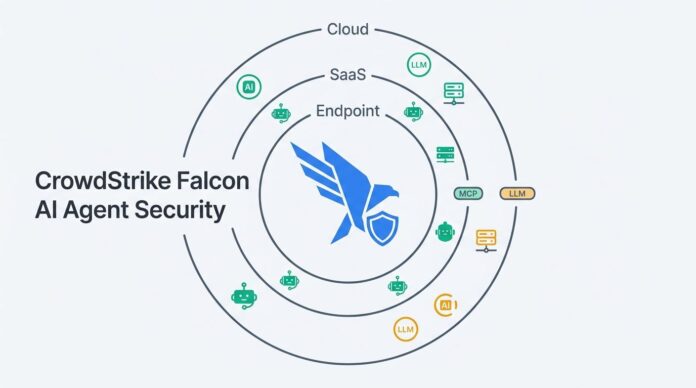


As businesses accelerate their adoption of artificial intelligence (AI), cybersecurity companies are developing new ways to ensure that increasingly autonomous systems remain under human control. CrowdStrike has introduced a new AI Kill Switch designed to help organisations stop rogue AI agents before their activities create wider security risks.
Announced on 3 November 2026 at Fal.Con Europe 2026 in Barcelona, the innovation forms part of CrowdStrike’s Falcon Guardian platform. It gives security teams the ability to intervene when an AI agent moves beyond its intended behaviour, helping organisations maintain control over automated processes operating across enterprise environments.
The announcement highlights an important development in enterprise technology: as AI systems become more capable of making decisions and performing tasks independently, organisations must also strengthen the security measures governing their activities.
Bringing Human Control Back into AI Operations
AI agents are increasingly being used to perform tasks that traditionally required human involvement. These systems can interact with applications, access information, communicate with other digital services and execute multiple actions as part of a single workflow.
While these capabilities offer opportunities to improve productivity and operational efficiency, they also introduce additional cybersecurity risks.
An AI agent that becomes compromised, manipulated or operates outside its authorised instructions could potentially access sensitive information, interact with systems inappropriately or trigger actions that affect wider business operations.
CrowdStrike’s AI Kill Switch is designed to address this challenge by giving authorised security personnel a way to stop an agent when its behaviour becomes unsafe.
According to the company, the technology enables security teams to terminate a rogue agent, prevent it from launching again and remove its enterprise network access. Actions are initiated by an authorised administrator and recorded in an audit trail, supporting accountability and oversight.
The intention is to ensure that businesses do not have to choose between adopting advanced AI technology and maintaining appropriate security controls.
How the AI Kill Switch Works
The new capability is integrated into CrowdStrike Falcon Guardian, which provides visibility into AI agents operating within enterprise environments.
The AI Kill Switch acts as an emergency control mechanism. When security personnel identify an agent behaving outside its intended boundaries, they can intervene to restrict its access and stop further activity.
CrowdStrike’s accompanying technical explanation describes how the Falcon AI Gateway can block access to the AI models powering agents. Organisations can use CrowdStrike’s own gateway or connect compatible third-party AI gateways.
The company’s broader development plans include extending coordinated containment across additional enforcement points, including endpoints, cloud environments and enterprise applications.
This is particularly relevant for organisations where AI agents operate across several interconnected platforms rather than within one isolated application.
The ability to intervene quickly could help reduce the impact of unauthorised activity while security teams investigate what happened.
CrowdStrike Expands Its AI Security Strategy
The AI Kill Switch was not the only significant development announced by CrowdStrike on 3 November.
The company also announced an agreement to acquire Dreadnode, a specialist in automated AI security testing. The proposed acquisition is intended to strengthen the Falcon platform’s ability to identify weaknesses in AI models, applications and agents before they are deployed into production environments.
CrowdStrike explained that conventional software security testing does not always identify vulnerabilities associated with AI systems. These can include prompt injection, model manipulation and attempts to bypass an AI application’s intended safeguards.
Dreadnode’s technology is expected to extend automated security testing into these areas, helping organisations identify and address weaknesses earlier in the development process.
The company stated that the automated AI security testing capabilities are expected to become generally available in the fourth quarter of its 2027 financial year. The acquisition remains subject to completion.
Together, these developments demonstrate how cybersecurity providers are expanding their focus beyond traditional computer networks to include the AI systems increasingly responsible for business decisions and automated activities.
What This Means for Businesses
For organisations investing in AI, the announcement reinforces the importance of establishing clear governance before deploying autonomous systems at scale.
Businesses need to understand which AI agents are operating within their environments, what information they can access, which actions they are authorised to perform and who is responsible for monitoring their behaviour.
Without appropriate oversight, an organisation could introduce security vulnerabilities while attempting to improve efficiency through automation.
Financial institutions, healthcare providers, retailers, telecommunications companies and public-sector organisations may face particular challenges because their digital operations involve sensitive information and interconnected systems.
For South African businesses, these considerations are increasingly relevant as organisations explore AI-powered customer services, data analysis, automated administration and digital transformation initiatives.
AI adoption should therefore be accompanied by access restrictions, monitoring, incident response procedures and clear accountability structures.
The introduction of tools such as the AI Kill Switch also raises an important management consideration: cybersecurity teams must be involved in AI deployment decisions rather than being brought in only after systems have been implemented.
The Future of AI Requires Security and Accountability
Artificial intelligence is moving beyond applications that simply respond to instructions. Autonomous agents are increasingly being developed to complete tasks, interact with digital environments and coordinate activities with limited human intervention.
This transition creates opportunities for businesses to improve productivity, but it also increases the importance of managing the risks associated with automated decision-making.
CrowdStrike’s latest announcement reflects a growing industry focus on making AI adoption more secure through visibility, testing, monitoring and human intervention.
The broader challenge for businesses will be ensuring that technological innovation does not outpace their ability to manage risk.
As organisations continue integrating AI into their operations, maintaining human oversight and establishing reliable security controls will become essential components of responsible digital transformation.