
At a time when South African agriculture faces drought warnings, high input costs and job losses, one crop offers a clear example of what sustained growth can look like. On 9 November, Wandile Sihlobo, South Africa’s agriculture and land envoy and chief economist of the Agricultural Business Chamber of South Africa (Agbiz), highlighted the country’s canola industry as a blueprint for agricultural expansion.
A remarkable growth story
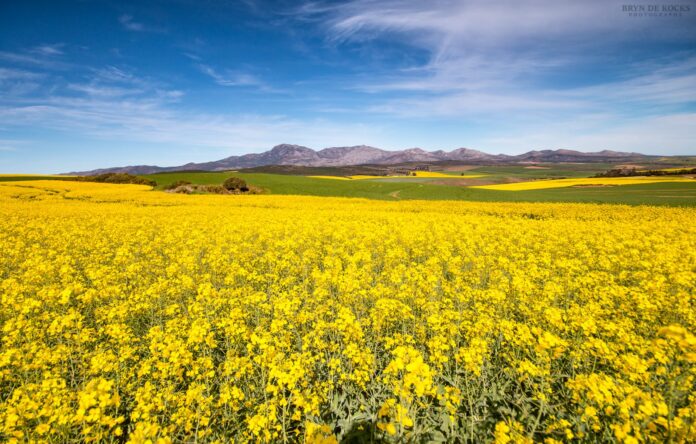
Canola is a relatively new crop in South Africa. Farmers began commercial planting on just 17,000 hectares in the 1998-99 season. For the 2026-27 season, the planted area is estimated at 197,890 hectares, more than eleven times the original footprint.
Production has followed. The final estimate for the 2025-26 canola crop was 306,000 tonnes, up 5% from the previous season.
Most importantly, South Africa has moved from relying on imports to becoming a net exporter of canola, with shipments to markets such as Germany and Belgium in recent years.
What drove the expansion
Several factors explain canola’s success. The main catalyst has been rising domestic demand for vegetable oils and oilcake, which is used in animal feed. As demand grew, investment in processing capacity followed, creating a reliable market for farmers.
Profitability has also played a role. In parts of the Western Cape, some farmers have switched land from wheat to canola because canola has offered better returns in recent seasons.
Production is concentrated in the Western Cape, where winter rainfall suits the crop. Canola also brings agronomic benefits when grown in rotation with wheat and barley, helping farmers break disease and weed cycles and spread their market risk.
The combination of demand, processing investment and farm-level profitability created the conditions for steady expansion. It is this combination that Sihlobo argues should inspire growth in other crops and regions.
A contrast with wheat
Canola’s progress stands out against the current difficulties facing other winter crops. Wheat production for the 2026-27 season has fallen to its lowest level in eight years, affected by unfavourable weather and rising input costs. As a result, South Africa is expected to import around 2 million tonnes of wheat.
The contrast shows how much a crop’s prospects depend on market demand, processing capacity and profitability, not only on weather. Where those elements are missing, even an established staple can struggle, leaving the country more dependent on imports and more exposed to global price swings and currency movements.
Unlocking land for commercial production
Sihlobo also pointed to an important policy development. Around 2.5 million hectares of land is earmarked for release to boost commercial agricultural production. The details of the land release are still being finalised.
He stressed that collaboration with commodity associations and agribusinesses will be key, and that the Department of Agriculture, together with the Department of Land Reform and Rural Development, should lead efforts on both land release and the productive use of that land. What is required now, he argues, is consistent implementation.
Why it matters for the wider economy
Agriculture remains an important source of jobs, exports and rural development. Yet the sector is under pressure. Statistics South Africa’s latest Quarterly Labour Force Survey, released on 10 November, showed agriculture among the sectors that shed the most jobs in the third quarter of 2026.
Weather risks are also rising. Agricultural researchers have warned farmers in parts of the country of below-normal rainfall this summer, linked to El Niño conditions.
Against this backdrop, the canola story carries a constructive message. Growth in agriculture is possible when demand, investment, processing and policy support align.
Lessons for agribusiness and investors
For agribusinesses, financiers and policymakers, canola offers several practical lessons.
First, demand-led growth is more sustainable than supply-led expansion. Canola grew because processors needed the crop and were willing to invest in capacity.
Second, value-chain investment matters as much as farm production. Processing plants created a dependable market and turned a niche crop into an export product.
Third, profitability drives adoption. Farmers switched to canola because the numbers worked, not because of mandates.
Fourth, land reform and productive use must go together. The 2.5 million hectares earmarked for release could support new value chains if paired with finance, skills and market access.
The road ahead
Sihlobo’s new book, Balance and Reason: A Growth Path for South Africa’s Agriculture, is available from 9 November. Its central argument echoes the canola experience: South African agriculture already has many success stories, and the task now is to replicate them across more crops and more regions of the country.
Source: Wandile Sihlobo, AgriView (author’s own publication) – https://wandile.substack.com