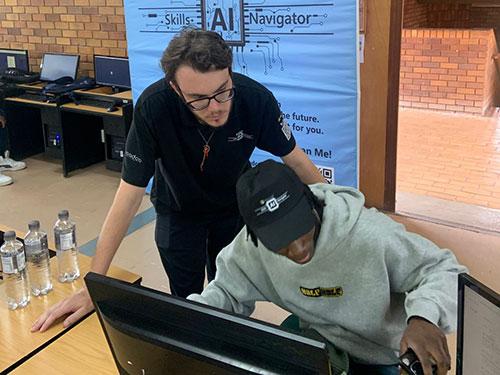
South Africa’s technical and vocational education sector is taking another step towards strengthening digital skills development following a new lecturer training initiative by Tshwane University of Technology (TUT). The programme is aimed at improving programming knowledge among lecturers from Technical and Vocational Education and Training (TVET) colleges, supporting the delivery of Coding and Robotics education across the country.
Announced by TUT on 10 November 2026, the initiative focuses on developing educators’ technical capabilities and strengthening their ability to prepare students for an increasingly technology-driven economy.
The programme, known as the NCV Technical Programming: Lecturer Development Short Learning Programme, is being delivered through TUT’s Faculty of Information and Communication Technology (ICT), under its Department of Computer Science.
It brings together lecturers from TVET colleges for specialised programming training designed to improve their understanding of programming languages, practical problem-solving and teaching methodologies.
13 TVET colleges participate in programming development initiative
One of the significant aspects of the initiative is its national reach. According to TUT, lecturers from 13 TVET colleges have participated in the training programme.
The participating institutions include Motheo, Mopani, Waterberg, Sedibeng, Flavius Mareka, Central Johannesburg, Nkangala, WestCol, Ehlanzeni, Ekurhuleni West, Umfolozi, King Sabata Dalindyebo and Vhembe TVET colleges.
The programme is structured around different levels of programming education, allowing lecturers to strengthen their technical knowledge progressively.
The first training session, covering NCV Level 2: Introduction to Python, took place between 19 and 23 October 2026.
This was followed by NCV Level 3: C/C++ Programming, conducted from 26 to 30 October 2026.
Participants engaged in practical learning activities and explored programming concepts relevant to the National Certificate (Vocational) Coding and Robotics curriculum.
The training sessions were facilitated by experienced academics and programming specialists, including Dr Bertie Buitendag, Tshepho Raphiri, Frederik Hattingh, Relebogile Langa, Kyle Stone and Vathisws Booi.
Strengthening the quality of vocational education
Beyond teaching lecturers how to use programming languages, the initiative also focuses on improving how technical subjects are delivered in classrooms.
TUT says the programme equips educators with teaching strategies that help students progress from foundational computational thinking and basic programming principles towards more advanced concepts.
Other areas covered include practical problem-solving, programming methodologies, curriculum interpretation and appropriate assessment approaches.
This is important because the effectiveness of vocational education depends not only on the availability of technical learning materials but also on educators who can translate complex concepts into practical knowledge.
Lecturers with stronger programming capabilities can help students understand how digital technologies work and how programming skills can be applied to real-world challenges.
For TVET institutions, strengthening lecturer development could also support the delivery of more relevant technical qualifications as industries increasingly incorporate automation, software and digital systems into their operations.
Long-standing collaboration with the TVET sector
TUT’s involvement in lecturer development is not a new undertaking.
Dr Bertie Buitendag explained that the university’s Department of Computer Science has maintained a working relationship with the Department of Higher Education and Training (DHET) and the TVET sector since 2006.
The collaboration began with the NCV Specialisation Programme in Computer Science and Information Technology.
The university subsequently expanded its involvement in training Coding and Robotics lecturers in collaboration with its Department of Mechatronics.
The current programme is supported through TUT’s Technology Station in Electronics, which operates within the Faculty of Engineering and the Built Environment.
This continued collaboration highlights the role universities can play in supporting vocational institutions through specialised academic knowledge, technical expertise and educator development.
Advanced Python training scheduled for November
The lecturer development programme is continuing, with another important training milestone planned for later this month.
According to TUT, the final training session, NCV Level 4: Advanced Python, is scheduled to take place from 16 to 20 November 2026.
Lecturers from Coastal KZN and Boland TVET colleges are expected to participate, joining colleagues from institutions represented during the earlier sessions.
The additional participation is expected to extend the programme’s national reach and strengthen collaboration between vocational institutions.
Advanced Python training will provide an opportunity for participating lecturers to deepen their understanding of programming concepts and build on the knowledge developed during earlier sessions.
What this means for South Africa’s future workforce
South Africa’s ability to compete in an increasingly digital economy will depend partly on how effectively its education system develops technical skills.
Programming, computational thinking and digital problem-solving are becoming increasingly relevant across industries, including financial services, manufacturing, telecommunications, engineering and technology.
TVET colleges have an important role in connecting education with practical workplace requirements. However, delivering relevant technical education requires lecturers who are equipped to teach emerging technologies and evolving industry practices.
Initiatives such as TUT’s lecturer development programme demonstrate how partnerships between universities and vocational institutions can contribute to strengthening this capacity.
The benefits could extend beyond the lecturers participating in the programme. Improved teaching capabilities can support students entering technical careers and businesses looking for employees with relevant digital competencies.
The initiative also highlights the importance of investing in educators as part of broader skills development strategies. While technology infrastructure and access to learning resources remain important, developing the people responsible for delivering education is equally essential.
As South Africa continues to strengthen its digital skills pipeline, sustained investment in lecturer development, practical training and collaboration between educational institutions and industry will remain important.
TUT’s programme provides an example of how higher education institutions can contribute to preparing the next generation of technically skilled graduates.