
South African businesses enter the final weeks of 2026 facing a familiar mix of relief and pressure. The temporary fuel levy reduction announced in the Medium-Term Budget Policy Statement (MTBPS) is now in effect, the rand has strengthened, and the South African Reserve Bank (SARB) is preparing for its last interest rate decision of the year. At the same time, rising producer prices signal that cost pressures have not gone away.
Fuel levy relief: what businesses get and when
Finance Minister Enoch Godongwana tabled the 2026 MTBPS on 21 October. Acknowledging the pressure that rising fuel prices are placing on households and businesses, he announced a temporary reduction in the fuel levy.
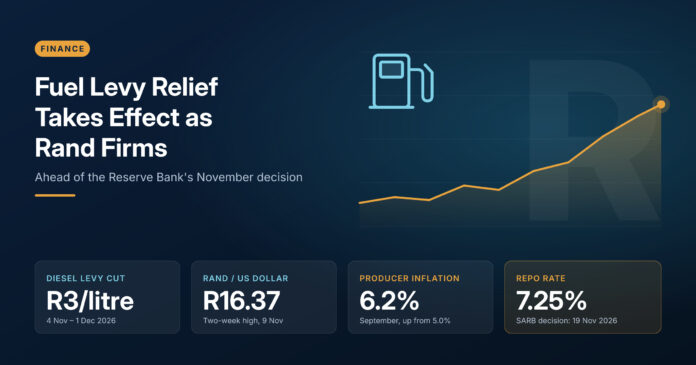
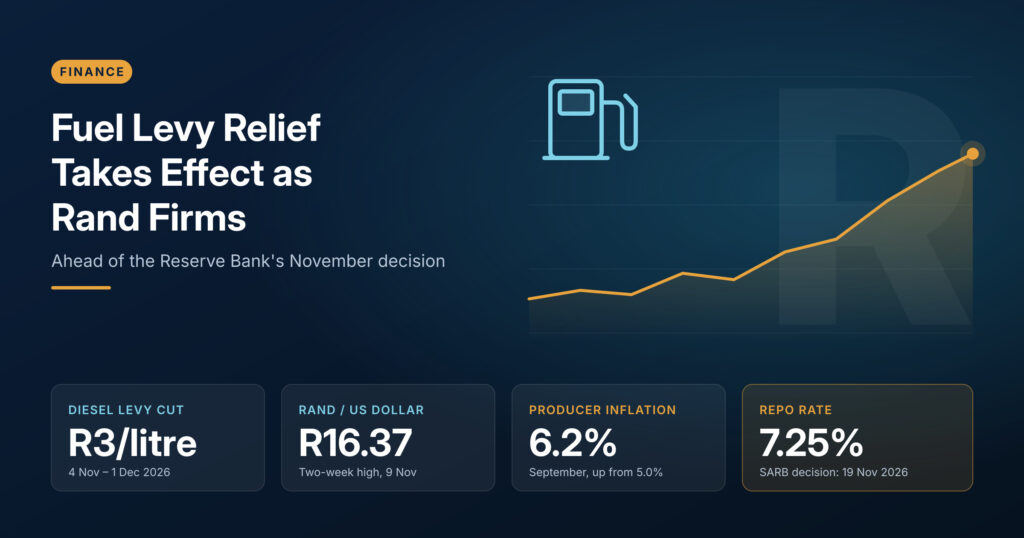
From 4 November until 1 December 2026, the fuel levy is reduced by R3 per litre for diesel and R1.50 per litre for petrol. After that, a smaller reduction continues until 5 January 2027: R1.50 per litre for diesel and R1 per litre for petrol.
The relief amounts to R10 billion in support. To fund it, the R10 billion previously transferred to the Central Energy Fund will be returned to the National Revenue Fund. The Minister said the intervention would ease cost-of-living pressures without compromising the sustainability of the budget.
For logistics, agriculture, mining and transport businesses, the larger diesel reduction is especially significant. Finance teams should ensure that fuel cost budgets for November, December and early January reflect both phases of the relief, and that diesel refund calculations account for the temporary change.
The broader fiscal picture
The MTBPS presented a fiscal position that is improving, even as growth weakens. The consolidated budget deficit for 2026/27 is projected at 3.9% of GDP, slightly better than the 4.0% estimated in February. The revenue estimate was revised upward by R17.1 billion, supported by stronger corporate tax, dividends tax and VAT collections.
Growth, however, remains the concern. The 2026 growth forecast was cut to 1.2% from the 1.6% projected in February, reflecting higher fuel prices, geopolitical tensions and the effects of El Niño.
The MTBPS also increased the general fuel levy allocation to municipalities by R13.4 billion, restoring the metros’ share to 23% over the medium term.
The rand: a two-week high
The rand has responded positively. On 9 November, the dollar fell 0.87% against the rand to R16.37, taking the local currency to a two-week high. Over the past month, the rand has strengthened by about 1%, and it is up about 4.5% over the past year.
The currency remains exposed to external factors. Precious metal prices, which support South Africa’s export earnings, have weakened, and global oil prices remain elevated because of ongoing conflict in the Middle East. United States inflation data and expectations about Federal Reserve policy will also influence the rand’s direction in the coming weeks.
For importers, a firmer rand offers some relief on the cost of foreign goods and equipment. Exporters, by contrast, may see their rand-denominated earnings narrow slightly.
Producer inflation is rising
Beneath the positive currency news, cost pressures are building. Statistics South Africa reported that producer prices rose 6.2% year on year in September, up from 5.0% in August. Producer inflation measures the prices that manufacturers and suppliers charge, and increases often feed through to consumer prices in later months.
This matters for every business that buys inputs, from raw materials to packaging. Procurement and finance teams should anticipate continued supplier price increases into the new year.
The Reserve Bank’s next move
All eyes now turn to the SARB’s Monetary Policy Committee, which announces its next decision on 19 November. The repo rate currently stands at 7.25%, after the SARB raised it from 7% in September.
The Reserve Bank’s task is complicated. Inflation is running above the new 3% target, producer prices are rising, and oil prices remain high. Yet economic growth is weak, and the labour market is under pressure. The committee must weigh the risk of inflation becoming entrenched against the risk of slowing an already fragile economy further. Its decision will shape borrowing costs for households and businesses well into 2027.
What it means for business
For CFOs and finance leaders, the coming weeks call for careful planning. The fuel levy relief provides a short-term cushion, but it is temporary and will step down in December. Rising producer prices point to higher input costs ahead. The interest rate decision will shape borrowing costs for 2027.
Businesses that stress-test their budgets against higher input costs, a possible further rate increase and currency volatility will be best placed to navigate the period ahead.
Source: National Treasury, 2026 Medium-Term Budget Policy Statement speech (as tabled in Parliament) – https://www.parliament.gov.za/storage/app/media/Pages/2026/16-10-2026_MTBPS_2026/speech/2026_MTBPS_Speech.pdf