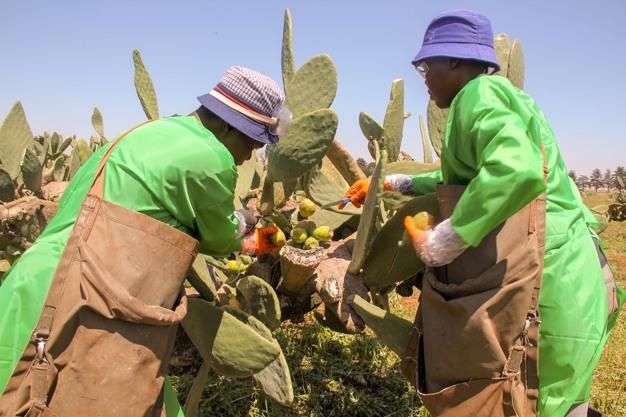
South African entrepreneur Samkelisiwe Chunda is demonstrating how indigenous crops, water-efficient technology and agricultural innovation can create new commercial opportunities while supporting sustainable food production.
South Africa’s agricultural sector continues to face increasing pressure from changing weather patterns, rising production costs and growing concerns about water availability. Against this backdrop, agricultural entrepreneurs are exploring alternative crops and innovative farming methods that can strengthen food production while creating new business opportunities.
One example is Samkelisiwe Chunda, founder of Sustainable AgriTech Systems, which operates as Sibayeni Metrofarming in Mpumalanga. Her agricultural enterprise is developing a commercial farming model centred on prickly pears, indigenous fruits, hydroponics and water-smart agricultural technology.
The development, highlighted on 16 November 2026, demonstrates how agricultural innovation can create value beyond traditional crop production.
From a Small Farming Operation to a 25-Hectare Enterprise
Chunda began her agricultural journey in 2013 using family land and initially financed the business through her salary. Rather than beginning with extensive commercial infrastructure, she gradually developed the operation by reinvesting available resources into production facilities and farming activities.
In 2018, she formally registered Sustainable AgriTech Systems, trading as Sibayeni Metrofarming.
What started as a relatively small operation has grown into an approximately 25-hectare agricultural enterprise. Around 16 hectares are dedicated to prickly pear cultivation, making the indigenous fruit a central part of the business.
The farm has also diversified into hydroponics, beekeeping, rabbit production and other indigenous fruit activities.
This diversification reflects a broader opportunity for agricultural businesses to explore alternative crops and production models that can respond to changing environmental and market conditions.
Prickly Pears Create New Value-Addition Opportunities
Prickly pears are increasingly attracting attention as farmers and entrepreneurs explore the commercial potential of indigenous and drought-tolerant crops.
At Sibayeni Metrofarming, the focus extends beyond selling fresh fruit. The enterprise is exploring opportunities to develop products from different parts of the prickly pear plant, including juices, teas and seed oils.
The business supplies fresh produce to established distribution channels, including Food Lovers Market, the Johannesburg International Fresh Produce Market and the Tshwane Market.
Value addition is particularly important for agricultural businesses because it creates opportunities to diversify revenue streams and reach customers beyond traditional fresh-produce markets.
For emerging farmers, processing and product development can also provide opportunities to build stronger agricultural businesses around locally available resources.
Water-Saving Technology Supports Climate-Smart Farming
One of the most interesting aspects of Chunda’s agricultural venture is its focus on water efficiency.
The enterprise has developed PEAR-H2O, a proprietary biodegradable hydrogel technology designed to improve water efficiency in agricultural production.
Water availability remains a major consideration for South African farmers, particularly as climate variability increases uncertainty around rainfall and growing conditions.
Technologies that help improve water management could therefore become increasingly important in supporting agricultural productivity.
Hydrogels are materials designed to absorb and retain water, potentially making moisture available to plants over time. Their agricultural application can support efforts to manage irrigation more efficiently, although performance depends on the specific formulation, soil conditions and farming practices.
The development of PEAR-H2O illustrates how agricultural enterprises can combine scientific knowledge with practical farming experience to explore solutions to production challenges.
For the wider agricultural sector, innovation in water management could help farmers investigate new ways of improving resource efficiency and building resilience.
Research, Innovation and Women’s Participation in Agriculture
Chunda’s professional background in environmental science and agriculture has influenced the direction of her business.
Her academic qualifications include environmental science studies, project management and an MBA in climate-smart agriculture. She is also pursuing doctoral research focused on the economic viability of agrivoltaics in South Africa.
Agrivoltaics involves combining agricultural production with solar energy generation on the same land.
This approach is attracting interest internationally because it offers the possibility of supporting food production and renewable energy generation together.
Chunda’s participation in agricultural innovation has also earned national recognition. Her business received third place in the Agricultural Development Agency awards, accompanied by a R24,000 prize package.
The enterprise currently supports 16 workers, comprising five permanent employees and 11 seasonal workers.
This highlights the potential contribution of agricultural entrepreneurship to employment creation, particularly in rural communities where new commercial opportunities can support local economic development.
Future Opportunities for South African Agriculture
Looking ahead, Sibayeni Metrofarming aims to establish a fully operational processing facility, expand PEAR-H2O production and advance its research into agrivoltaic systems.
The business also hopes to develop its farm into a demonstration centre for emerging farmers.
These ambitions reflect several important developments shaping the future of agriculture: climate resilience, water conservation, indigenous crop development, renewable energy and value-added agricultural products.
However, expanding these opportunities will require investment, suitable infrastructure, technical research and access to reliable markets.
For emerging agricultural businesses, understanding production costs and identifying customers before expanding operations will remain essential.
South Africa’s agricultural future will depend not only on large-scale commercial production but also on the ability of innovative farmers and entrepreneurs to identify new opportunities and develop practical solutions.
Chunda’s journey illustrates how indigenous crops and scientific innovation can contribute to this evolving landscape.
As the sector continues to navigate environmental and economic pressures, ventures such as Sibayeni Metrofarming offer an example of how sustainable farming practices and value addition can help create new possibilities for agriculture.
Read more:https://www.foodformzansi.co.za/trailblazer-unlocks-the-hidden-gold-of-prickly-pear-farming/