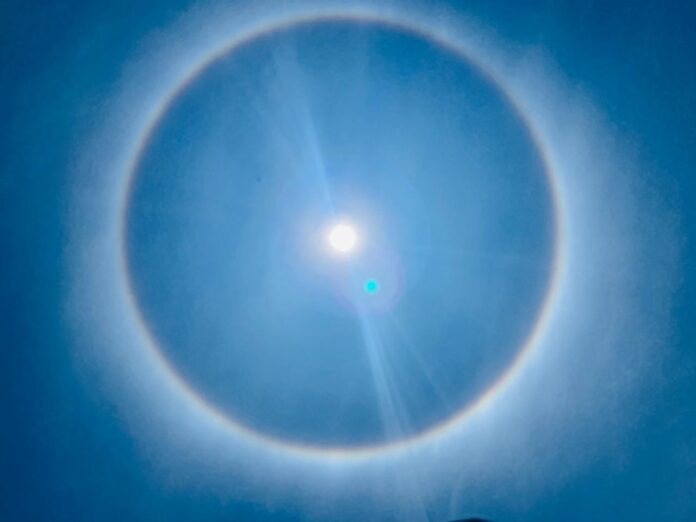

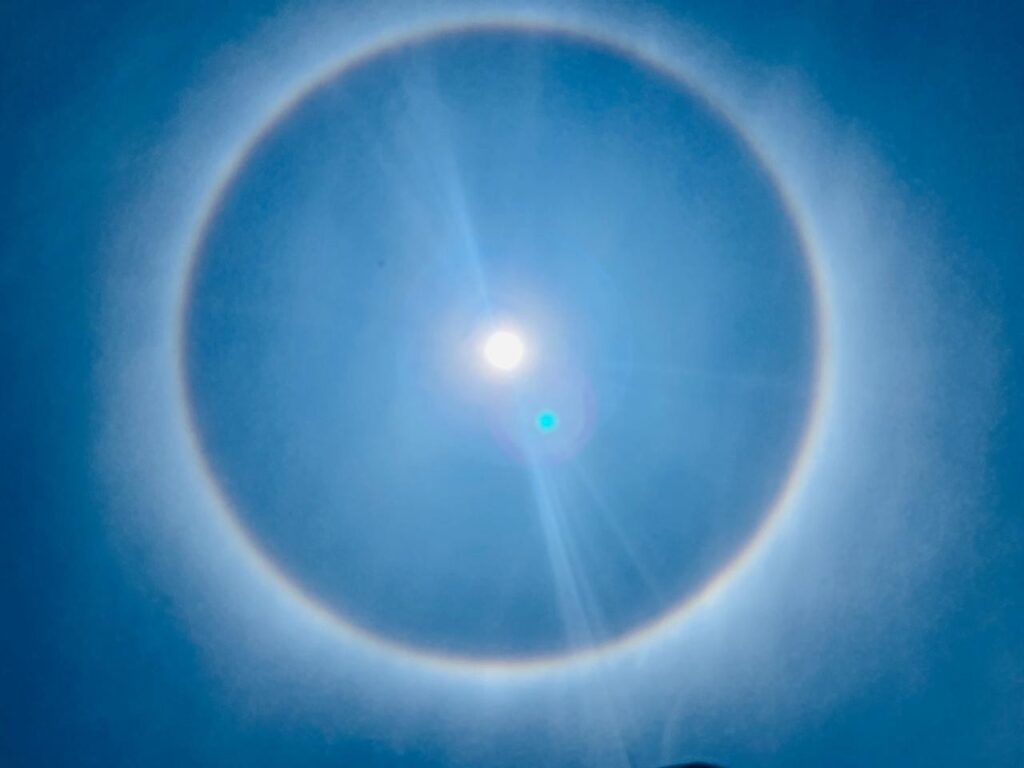
Johannesburg residents were treated to an unusual natural spectacle on Monday, 16 November 2026, as a bright circular ring appeared around the Sun, attracting attention across different parts of Gauteng. The striking display, known as a 22-degree solar halo, prompted residents to look towards the sky, photograph the phenomenon and share their observations online.
Reports from Johannesburg communities indicated that the halo was visible from several locations, including the West Rand, Soweto, Pretoria and Melrose Arch. The appearance of the luminous ring generated curiosity among residents, with many wondering what could cause such a distinctive formation around the Sun.
Although the phenomenon can look extraordinary, it has a scientific explanation rooted in atmospheric optics.
What exactly is a 22-degree solar halo?
A 22-degree solar halo is an optical phenomenon that occurs when sunlight interacts with tiny ice crystals suspended in high-altitude clouds. These crystals are commonly found in cirrus and cirrostratus clouds, which often appear as thin, white, feather-like formations across the sky.
According to the World Meteorological Organization (WMO), the 22-degree halo is the most frequently observed type of atmospheric halo. It appears as a luminous circular ring surrounding the Sun or Moon, with a radius of approximately 22 degrees.
The ring is generally white or mostly white, although faint colours may be visible. A reddish fringe can sometimes be seen along its inner edge, while the outer edge may display subtle violet colouring.
The measurement refers to the angular distance between the centre of the Sun and the halo, rather than the physical size of the ring.
How does sunlight create the circular ring?
The formation of a solar halo involves a process called refraction, which occurs when light changes direction as it passes from one medium into another.
High above the Earth’s surface, ice crystals develop within cold atmospheric clouds. Many of these crystals have six-sided, hexagonal structures.
When sunlight enters these crystals and passes through their faces, it bends as it travels through the ice and emerges into the surrounding air. The geometry of the crystals causes the light to be redirected at angles that produce the familiar 22-degree halo.
Millions of tiny ice crystals contribute to the display. Their combined effect creates the appearance of a broad circular ring around the Sun.
The shape and brightness of the halo depend on factors such as the concentration, orientation and distribution of ice crystals within the atmosphere.
Unlike a traditional rainbow, which forms through the interaction of sunlight and water droplets, a solar halo is primarily associated with ice crystals in high-altitude clouds.
Does a solar halo mean that rain is coming?
The appearance of a solar halo is sometimes associated with changing weather conditions.
This is because cirrostratus clouds can develop ahead of approaching weather systems and atmospheric fronts. Their presence may therefore indicate that conditions could change in the hours or days ahead.
However, seeing a 22-degree halo does not automatically mean that rain is coming.
The UK Met Office explains that halos are atmospheric optical effects produced by ice crystals in high clouds. While these clouds can be associated with approaching weather fronts, a halo alone cannot provide a reliable weather forecast.
Residents should continue to follow official weather forecasts and warnings rather than relying on the appearance of a halo to predict rainfall.
Is the phenomenon dangerous?
A solar halo itself is a natural optical effect and is not considered a direct danger to people.
However, observing it requires caution because the Sun remains extremely bright, even when surrounded by a visible ring.
Looking directly at the Sun, whether with the naked eye, binoculars or an ordinary camera viewfinder, can damage eyesight. Residents should never stare at the Sun in an attempt to observe the full halo.
Photographs should be taken carefully, using appropriate equipment and without looking directly at the solar disc.
The phenomenon can often be appreciated by observing the surrounding ring indirectly while keeping the eyes away from the Sun itself.
A reminder of the science happening above us
The 22-degree solar halo is a reminder that some of the most impressive natural displays do not require unusual astronomical events or special equipment. They can emerge through the everyday interaction between sunlight, atmospheric conditions and microscopic ice crystals.
For residents who witnessed Monday’s display, the experience offered an opportunity to appreciate the science behind an otherwise mysterious-looking feature in the sky.
Although the ring may disappear as cloud conditions change, the physics responsible for its formation remains an important part of atmospheric science.
As South Africans continue sharing photographs and observations of unusual weather and sky phenomena, understanding the science behind these events helps separate fascinating natural occurrences from myths and misconceptions.
The next time a luminous circle appears around the Sun, it may not be a sign of something extraordinary happening in space. Instead, it could be a beautiful demonstration of how sunlight interacts with Earth’s atmosphere.
Read more: https://cloudatlas.wmo.int/en/22-halo.html