
South Africa’s mining and construction sectors are heading into the final quarter of 2026 with contrasting signals. Mining volumes are under significant pressure, yet higher prices are supporting revenue. Construction, by contrast, has a firm pipeline of public projects moving towards procurement. This week’s announcements from industry bodies and listed companies show what each trend means for operators, contractors and suppliers.
Mining production falls 12.7%, but sales remain resilient
The Minerals Council South Africa reported on 14 October that mining production fell 12.7% year on year in August 2026. Seasonally adjusted output was 5.4% lower than in July, and production for January to August is down 1.3% on the same period of 2025.
Three commodities accounted for most of the decline. Platinum group metals (PGMs) fell 22.5%, iron ore 16.2% and coal 11.7%. Together they make up almost 70% of the country’s mining basket. Chromium and manganese were the only commodities to record growth in August.
[INSERT IMAGE: mining-production-august-2026.png]
Caption: South African mining production, year-on-year change in August 2026. Source: Minerals Council South Africa.
Revenue tells a different story. Seasonally adjusted mineral sales for the first eight months of the year were R108 billion higher than in the same period of 2025. That reflects strong prices: in August, gold traded 31.2% higher year on year at US$4,419 an ounce, platinum rose 33.6% to US$1,782 and coal gained 20.3%.
The Minerals Council cautions against reading too much into the sales figures. Its Chief Economist, Bongani Motsa, notes that revenue performance is “being supported by price effects rather than by expanding production volumes”, and that “this support should not be mistaken for a broad-based recovery.”
Cost pressures persist. Diesel prices remain more than 40% above March 2026 levels, and the Council points to operational and logistical constraints, rising input costs and weak export momentum. PGM export volumes fell 44% month on month in August.
R395 billion construction pipeline moves towards procurement
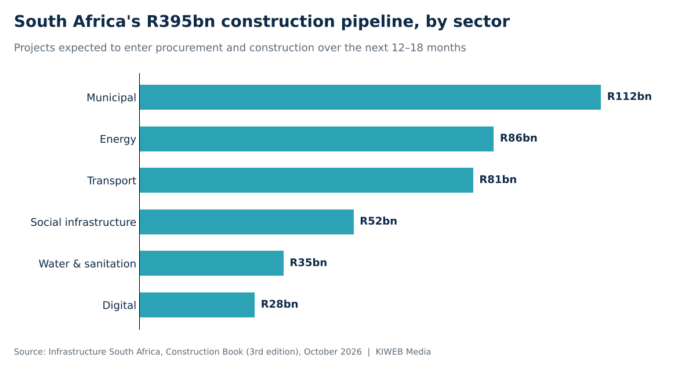
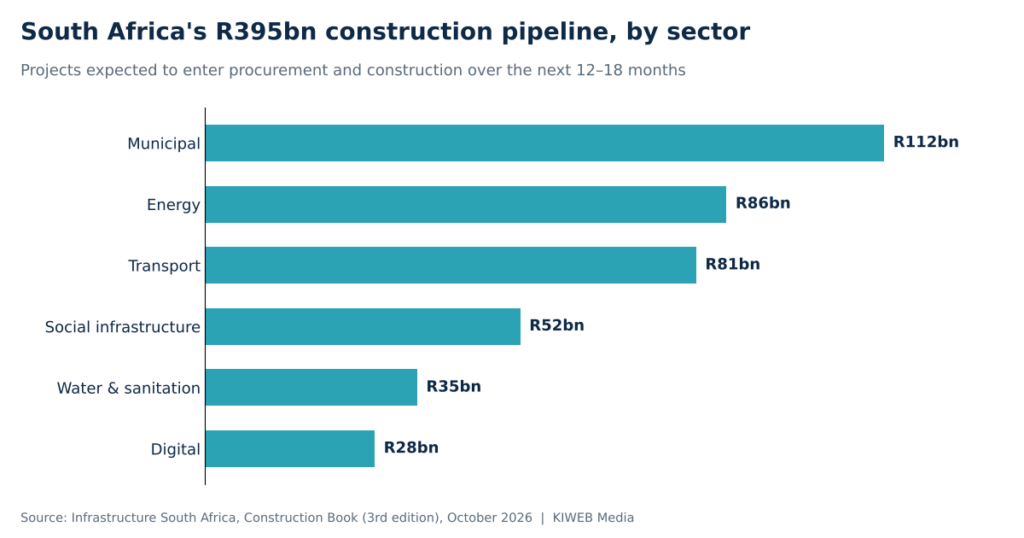
For the construction sector, the more encouraging news came from Infrastructure South Africa (ISA). On 12 October, ISA published details of the third edition of its Construction Book. The book lists about 110 public infrastructure projects worth approximately R395 billion. These projects are expected to enter procurement and construction over the next 12 to 18 months.
The pipeline is spread across six sectors. Municipal projects make up the largest share at about R112 billion, followed by energy at R86 billion and transport at R81 billion. Social infrastructure accounts for R52 billion, water and sanitation for R35 billion, and digital infrastructure for R28 billion.
[INSERT IMAGE: isa-construction-pipeline-by-sector.png]
Caption: Projects in ISA’s Construction Book (third edition), by sector. Source: Infrastructure South Africa.
This edition includes public-private partnership (PPP) projects for the first time, a notable change for private contractors and financiers looking for co-investment opportunities. ISA has also committed to publishing quarterly updates that track tenders issued, contract awards and construction starts. The agency says the aim is to identify delays early and improve transparency.
For contractors, suppliers and professional service firms, the book provides a rare forward view of public work. Firms that align their bidding capacity, funding and partnerships with the published pipeline now will be better placed when tenders open.
Sibanye-Stillwater settles US labour dispute
In the labour arena, Sibanye-Stillwater announced on 7 October that it had concluded a collective bargaining agreement with the United Steel Workers International Union. The agreement covers its Stillwater East mine and Columbus metallurgical facility in Montana. It ends a strike that began on 3 September.
The three-year agreement runs from 1 June 2026 to 31 May 2029. It provides a 4.5% increase in the first year, followed by the greater of 3.5% or inflation in year two and the greater of 3.0% or inflation in year three. Employees were scheduled to return to work on 9 October.
Richard Stewart, Chief Executive Officer of Sibanye-Stillwater, described the agreements as supporting “the long-term sustainability and competitiveness” of the group’s US PGM operations. A settlement at the East Boulder mine was finalised on 30 September. Labour stability is now in place across the group’s US PGM assets just as PGM prices are recovering strongly.
What to watch next
Two scheduled releases will show whether these trends continue. Anglo American publishes its third-quarter production report on 20 October 2026. Sibanye-Stillwater follows with its Q3 operating update on 5 November 2026. ISA’s first quarterly progress update on the Construction Book will show how quickly the R395 billion pipeline turns into tenders on the ground.
For mining, the question is whether high prices can keep cushioning falling volumes. For construction, the next 12 to 18 months will test whether a published pipeline translates into contracts awarded and work started.