
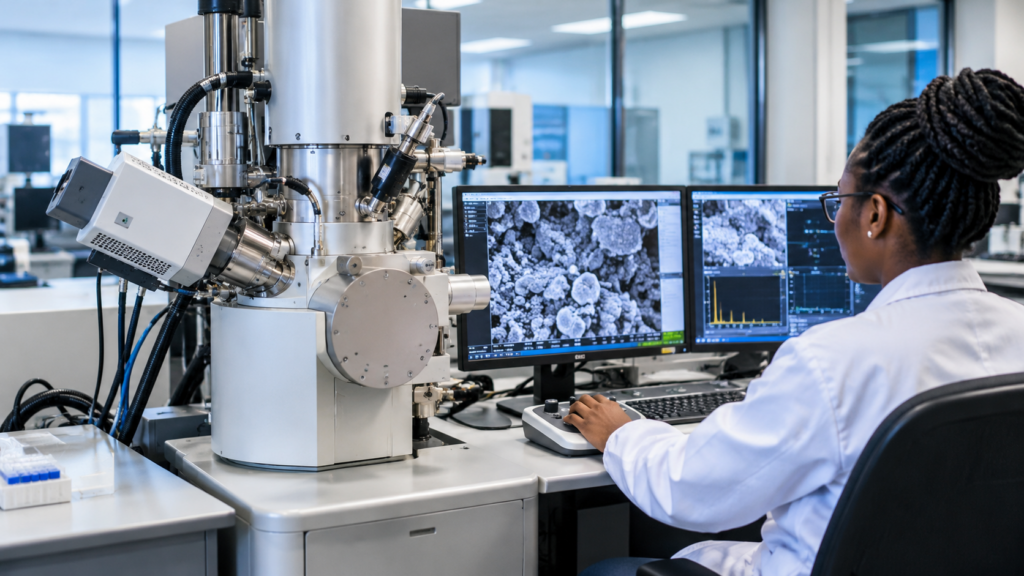
GQEBERHA, South Africa — South Africa’s capacity to study materials at the micro- and nanoscale has received a significant boost following the unveiling of two new scanning electron microscopes (SEMs) at Nelson Mandela University’s Centre for High Resolution Transmission Electron Microscopy (CHRTEM).
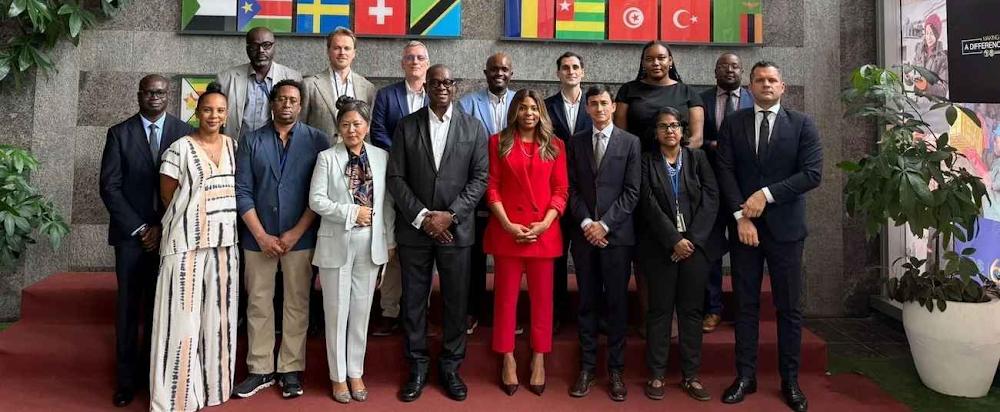
Deputy Minister of Science, Technology and Innovation Dr Nomalungelo Gina unveiled the instruments on 14 October 2026 at the university’s South Campus in Gqeberha, as the centre marked its 15th anniversary. The new systems replace ageing equipment and deliver greater stability, faster image acquisition, stronger signals and sharper imaging than their predecessors.
Why the upgrade matters now
The investment arrives at a critical point. CHRTEM’s original instruments are nearing the end of their manufacturer support, and without renewal, the centre risked losing ground in a field where measurement precision determines research quality.
Centre director Professor Jaco Olivier described the acquisition as a strategic phase of infrastructure renewal. He noted that it substantially broadens the university’s capability in advanced scanning electron microscopy and interdisciplinary bioimaging, helping South Africa remain competitive internationally.
For Dr Gina, the milestone demonstrated that national research infrastructure must evolve continuously to stay relevant. She argued that sustained public investment is what allows South Africa to compete in advanced materials characterisation as emerging technologies demand ever-greater precision at ever-smaller scales.
Fifteen years of public and private co-investment
CHRTEM was established in 2011 with R90 million from the Department of Science, Technology and Innovation (DSTI) and the National Research Foundation (NRF). The Department of Higher Education and Training added R30 million for the centre’s building.
Industry has also played a role. At a gala dinner held to mark the anniversary, the Deputy Minister acknowledged partners including Sasol, Element Six and Pebble Bed Modular Reactor for co-investing alongside government over the years — an example of how shared infrastructure can serve both academic research and industrial problem-solving.
The centre’s track record supports that model. Over its first 15 years, CHRTEM has logged more than 40,000 microscope hours, supported and trained about 1,000 students and completed over 700 research projects.
What scanning electron microscopes do for industry
SEMs produce detailed images of a specimen’s surface and composition. At CHRTEM, they are used extensively to study structural materials, particularly steel and aluminium alloys.
That capability has direct commercial relevance. Engineers and researchers can use SEM analysis to identify defects, corrosion, fatigue and wear that affect the performance and lifespan of components. For South African sectors such as mining, mineral beneficiation, heavy manufacturing and energy, better insight into material failure can translate into improved processes, safer infrastructure and reduced costs.
The new instruments also extend the centre’s work beyond traditional materials science into biomedical imaging and the bioeconomy — the use of biological resources and knowledge to create products, services and industrial applications. This opens room for collaboration with researchers in health sciences, agriculture and the life sciences.
Africa’s only atom-level microscope
Beyond the new SEMs, CHRTEM houses a distinction no other facility on the continent can claim: a double aberration-corrected transmission electron microscope. According to Dr Gina, it is “the only place in Africa where scientists can physically see and manipulate atoms.”
Transmission and scanning electron microscopy are complementary. Transmission systems examine electrons passing through ultra-thin specimens to reveal atomic structure, while SEMs map surface features and composition. Used together, they give researchers a more complete understanding of how materials are built and how they behave.
The Deputy Minister also welcomed news that Morocco is installing its own aberration-corrected microscopy infrastructure, describing growth across the Global South as validation of the path South Africa chose 15 years ago and an opportunity for greater African scientific collaboration.
Building skills, not just facilities
Equipment alone does not create innovation. Operating advanced microscopes and interpreting the data they generate requires specialised expertise, and CHRTEM has become an important training ground for postgraduate researchers from institutions across South Africa and abroad.
Shared national facilities of this kind are particularly valuable for researchers whose own institutions cannot afford comparable equipment, widening access to world-class tools and encouraging cross-institutional work.
Looking ahead
Dr Gina urged the centre to keep looking beyond the horizon, confirming that the DSTI remains committed to supporting strategic research infrastructure through mechanisms such as the South African Research Infrastructure Roadmap.
She noted that the centre’s work has progressed from locating atoms to understanding how they behave — a shift aligned with the country’s science policy goal of preparing for a digital, tech-driven future.
The wider economic return will depend on how effectively research findings move into products, industrial processes and commercial partnerships. But with renewed instruments in place, CHRTEM enters its next 15 years equipped to support that work at a higher level of precision.
Source: Nelson Mandela University, New microscopes boost South Africa’s advanced research capacity, 15 October 2026.