
The University of the Witwatersrand (Wits) and Bidvest Services International have deepened their working relationship with the launch of the Wits Bidvest Chair in Smart Solutions, a three-year research initiative backed by a R6 million commitment from Bidvest Services International. Announced on 15 October 2026, the Chair is designed to accelerate research, innovation and the development of advanced technical skills in some of the fastest-moving fields in the global economy: telecommunications, artificial intelligence (AI) and smart technologies.
The new Chair will sit within the School of Electrical and Information Engineering, part of the Faculty of Engineering and the Built Environment at Wits. Its stated purpose is to produce solutions that respond directly to industry needs, to strengthen postgraduate research, and to turn academic expertise into practical applications that address real challenges facing business and society.
From pilot collaboration to formal research chair
The announcement does not represent a first meeting between the two organisations. It follows roughly 18 months of research collaboration between Wits and Bidvest, driven largely through the engagement of Professor Ling Cheng with the company. That earlier work built trust and demonstrated value, laying the groundwork for a more structured, longer-term arrangement.
Professor Cheng, a Full Professor in the School of Electrical and Information Engineering, has been appointed as the Wits Bidvest Chair Holder and will lead the initiative. His research background spans telecommunications, AI and renewable energy, giving the Chair a strong multidisciplinary foundation. Under his leadership, the programme will bring together academic researchers, postgraduate students and industry partners to work on shared problems.
Speaking about the launch, Professor Cheng emphasised that “strong partnerships between universities and industry are essential” if research is to move beyond the laboratory. He noted that the Chair creates room to build on the existing collaboration with Bidvest, to develop research talent, and to investigate how AI-assisted technologies can help resolve challenges across industry and the wider community.
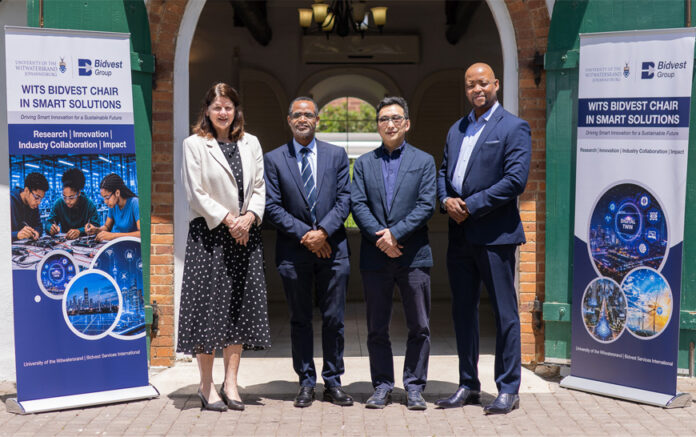
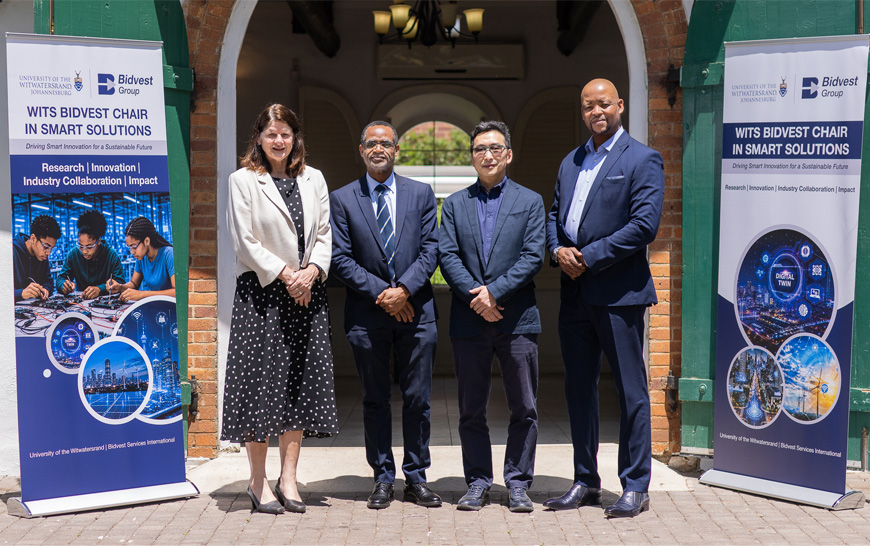
The launch event was attended by senior leaders from both institutions, including Professor Lynn Morris, Deputy Vice-Chancellor: Research and Innovation at Wits; Professor Cuthbert Musingwini, Dean of the Faculty of Engineering and the Built Environment; and Webb Meko, Chief Executive Officer of Bidvest FM.
Closing the gap between research and implementation
For South African business leaders, the significance of the Chair lies in its intent to narrow the long-standing gap between fundamental research and practical deployment.
By aligning research priorities with real operational challenges, the Chair aims to generate research-led solutions that are commercially relevant while also contributing to technological progress in South Africa and across the African continent. The focus areas open the door to applications in interconnected systems, intelligent infrastructure and other environments where advanced communications and AI can improve decision-making and operational efficiency.
For a services group such as Bidvest, which manages facilities, infrastructure and complex service operations at scale, these capabilities carry clear potential. Smart building management, predictive maintenance, connected sensor networks and data-driven resource planning are all areas where telecommunications and AI increasingly intersect. Readers interested in the projects already underway can explore the university’s Digital Smart Lab exhibition platform.
Building the next generation of technical talent
Postgraduate development is positioned at the heart of the initiative. South Africa faces a well-documented shortage of highly specialised engineering and data science skills, and the Chair seeks to address this by expanding opportunities for students to participate in collaborative, industry-linked research projects.
The initiative will support postgraduate supervision and increase research output, giving emerging researchers exposure to complex, real-world problems. In doing so, it aims to produce graduates who are not only academically strong but also equipped to contribute meaningfully to industrial innovation and the broader economy.
The partnership is also expected to create a two-way channel for knowledge exchange. Wits researchers gain insight into the practical constraints and priorities of a major corporate partner, while Bidvest gains access to cutting-edge thinking and a pipeline of skilled talent.
A model for strategic industry investment
Over its three-year term, the Chair intends to establish a sustainable foundation for collaborative research, technological innovation and human capacity development. It also offers a valuable reference point for other South African corporates weighing how best to invest in research and future skills.
For executives and decision-makers, the message is clear. As AI and smart technologies reshape industries, organisations that build structured relationships with universities are better placed to access new ideas, solve operational problems and secure the talent they will need in the years ahead. The Wits Bidvest Chair in Smart Solutions offers a compelling, practical example of how targeted corporate investment can strengthen academic institutions, develop future-ready skills and deliver solutions with tangible value for South Africa and the wider region.