
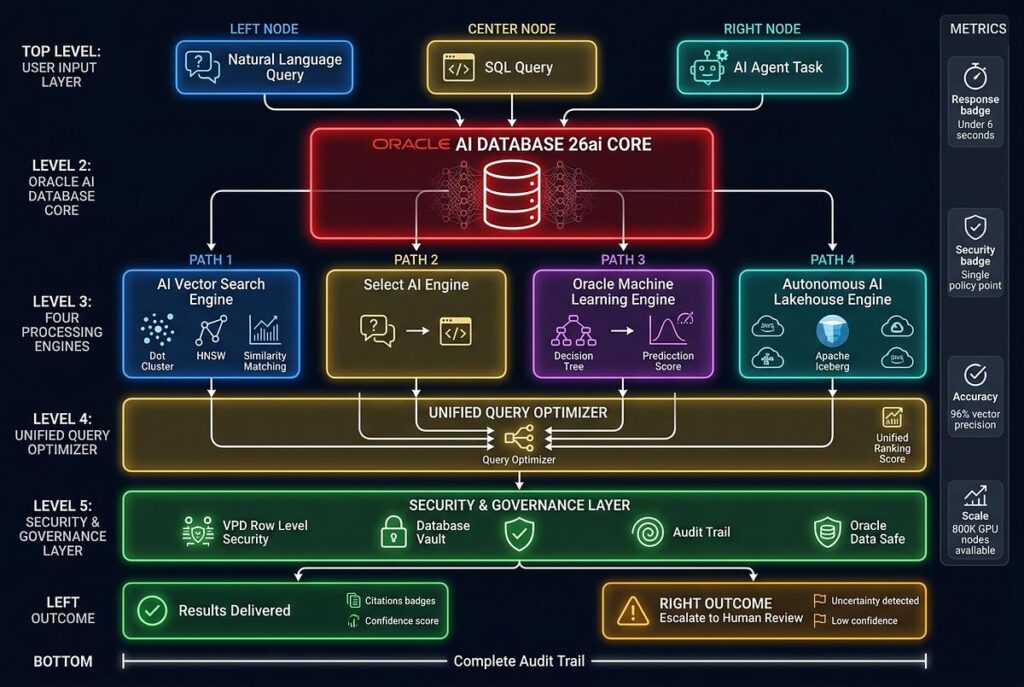
r concern: ensuring that sensitive information remains protected when accessed by AI applications and agents. Oracle’s Deep Data Security capabilities allow organisations to define access rules directly within the database, helping ensure that users and applications can access only information they are authorised to see.
This approach is intended to reduce dependence on security controls implemented solely within application code. If an AI agent accesses a database through a different route, application-level restrictions alone may not provide sufficient protection.
The data-access layer focuses on limiting what AI systems can do with business information. Oracle’s Trusted Data APIs are designed to provide controlled access to business objects, such as purchase orders, instead of giving AI agents unrestricted access to database operations.
The fourth layer concerns application development. Oracle APEX AI Application Generator can translate natural-language descriptions into application definitions that are executed through the APEX platform. Oracle says this approach separates AI-generated application functionality from the underlying execution environment, which provides enterprise security and operational capabilities.
Together, these layers are designed to help organisations introduce AI while maintaining stronger control over information, business processes and application behaviour.
Why AI Governance Is Becoming a Business Priority
The growing use of AI agents introduces questions that extend beyond the accuracy of AI-generated answers.
Businesses must consider which information an agent can access, whether it can change records, how it verifies business rules and what happens when it receives an incorrect instruction.
For example, an AI-powered finance application might help employees process expenses or retrieve financial information. Without appropriate controls, however, an application could expose confidential records or attempt transactions that exceed an employee’s authorised spending limit.
By placing certain rules directly within the database and application infrastructure, Oracle aims to make those controls more consistent across different applications and AI agents.
The announcement also highlights the importance of context when organisations use AI to analyse business information. Oracle’s Deep NL2SQL capabilities are designed to help AI interpret questions using an organisation’s business terminology and data definitions. Feedback and verification mechanisms are intended to help improve answers and validate changes to the underlying knowledge.
These capabilities matter because an AI system can produce a plausible answer that is nevertheless incorrect if it misunderstands a question or uses the wrong business definitions.
For organisations making decisions based on financial, operational or customer information, reliable answers are as important as the speed at which they are produced.
Cybersecurity and Verification Remain Critical
Oracle’s announcement arrives amid wider technology-industry efforts to improve the security of AI systems.
On 26 October, Microsoft also published an article titled “When AI rewrites millions of lines of code, verification becomes essential”, highlighting the importance of verifying software as AI increasingly contributes to code generation.
Google, meanwhile, published information on 20 October about compromised eMudhra intermediate certificate-authority keys affecting the Chrome and Android security ecosystem. Google described actions taken to block affected certificates and remove a related root certificate from the Chrome Root Store, with the wider rollout expected on 27 October Pacific time.
These developments concern different parts of technology infrastructure, but they point to a common priority: organisations and technology providers must verify systems, maintain security controls and respond quickly when risks emerge.
For businesses, adopting AI should therefore involve more than selecting a model or purchasing an application. Security testing, access management, monitoring, software maintenance and human oversight remain essential.
What the Development Means for Businesses
Oracle’s Deep Trust AI Architecture provides a framework for organisations evaluating how to move AI projects into production while maintaining governance and control.
Technology leaders should assess where their sensitive data is stored, how AI agents access it, whether business rules are enforced consistently and how generated applications are tested before deployment.
They should also establish clear accountability for AI-assisted decisions and ensure that employees understand the limitations of automated systems.
The practical value of an enterprise AI solution will depend not only on its capabilities but also on how effectively it fits into existing security, compliance and operational processes.
For South African organisations, these considerations are relevant across financial services, telecommunications, retail, mining, manufacturing and the public sector, where digital transformation increasingly depends on the responsible use of data.
Oracle’s announcement does not eliminate the need for independent security assessments or sound governance. Instead, it highlights an architectural approach to addressing some of the risks associated with expanding AI adoption.
As businesses move from AI experimentation to operational deployment, the next stage of competition may depend as much on reliability and trust as on intelligence and automation.