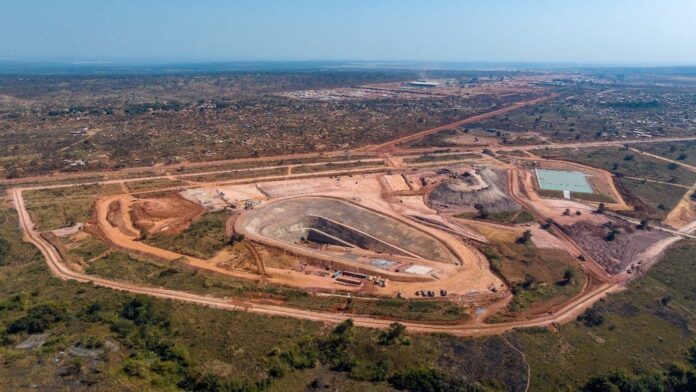

Few mining projects on the African continent have generated as much attention over the past two years as the Kamoa-Kakula Copper Complex in the Democratic Republic of Congo (DRC) — and Ivanhoe Mines’ latest quarterly update suggests the operation is finally moving from a period of recovery back toward growth.
The company reported that Kamoa-Kakula produced 64,328 tonnes of copper during the second quarter of 2026, with management pointing to improved mining rates and the planned drawdown of stockpiled copper inventories as reasons to expect a stronger second half of the year. That recovery follows a difficult stretch for the operation: seismic activity at the Kakula Mine in May 2025 forced Ivanhoe’s engineering team to implement a multi-stage dewatering and rehabilitation plan, work that dominated much of the company’s operational updates through the second half of last year. By early 2026, the company confirmed that Stage Two dewatering had been completed and that selective mining had resumed on the eastern side of the Kakula Mine ahead of schedule — a sign of how quickly the recovery effort has progressed.
Kamoa-Kakula’s significance extends well beyond its own production figures. The complex is one of the highest-grade copper operations in the world, and its on-site smelter — a state-of-the-art, 500,000-tonne-per-annum direct-to-blister facility — is the largest of its kind in Africa. The smelter produced its first copper anodes in late December 2025, roughly five weeks after start-up, and has since enabled Kamoa-Kakula to shift away from exporting raw copper concentrate toward producing higher-value, market-ready copper anodes for direct sale. Ivanhoe’s leadership has described this transition as transformational not just for the company, but for the DRC’s broader copper industry, positioning the country to capture more value from processing rather than simply exporting ore.
Energy infrastructure is another area of major investment at the site. Commissioning of a 60MW solar facility with battery backup is currently underway, with full capacity targeted by the end of the third quarter of 2026. This follows the completion of mechanical and electrical work on Turbine #5 at the refurbished Inga II hydroelectric facility, a project that has been years in the making and is intended to help secure reliable power for the wider Kamoa-Kakula operation and surrounding region. Power availability has historically been one of the more persistent constraints on large-scale mining and processing investment in the DRC, making these energy projects as strategically important as the mining operations they support.
Elsewhere in Ivanhoe’s Southern African portfolio, the company confirmed that ramp-up of Shaft #3 at its Platreef platinum-palladium-nickel-rhodium-gold-copper mine in Limpopo, South Africa, is now complete, with the project’s Phase 2 expansion on track for completion in the fourth quarter of 2027. The Kipushi zinc-copper-germanium-silver mine, also located in the DRC, delivered a record 70,177 tonnes of zinc in concentrate during the quarter — an 8% increase over the previous quarter — underlining that Ivanhoe’s growth story in the region extends across multiple metals, not just copper.
Longer term, the company continues to explore an extensive licence area in the Western Forelands, which it describes as more than six times larger than the existing Kamoa-Kakula complex and includes high-grade discoveries in the Makoko District. Ivanhoe is also pursuing new sedimentary copper discoveries beyond the DRC, including exploration efforts in Angola, Kazakhstan, and Zambia — part of a broader strategy to secure future copper supply as global demand tied to electrification and the energy transition continues to grow.
For a region often characterised in international coverage by operational risk and infrastructure constraints, the pace of recovery and investment at Kamoa-Kakula offers a different narrative: one of a maturing, increasingly self-sufficient mining and processing hub that is beginning to capture more of the value chain locally, from ore extraction through to finished copper anode production.