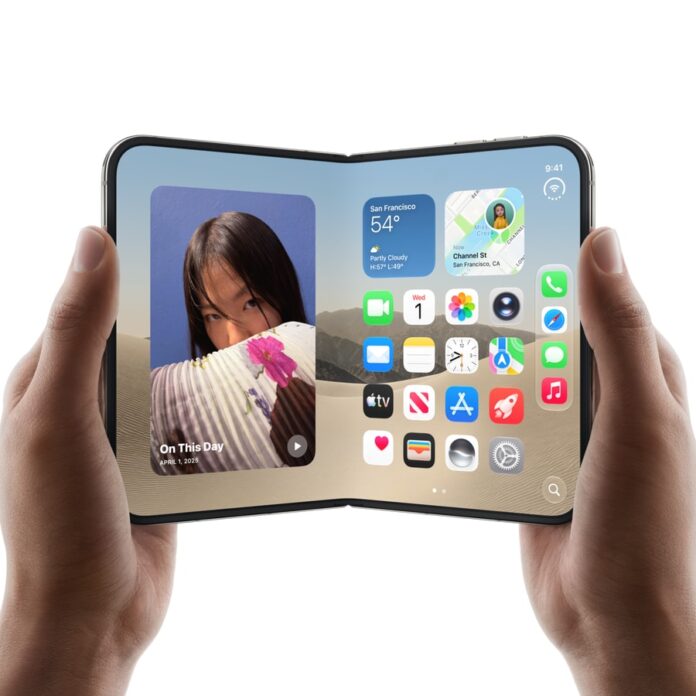

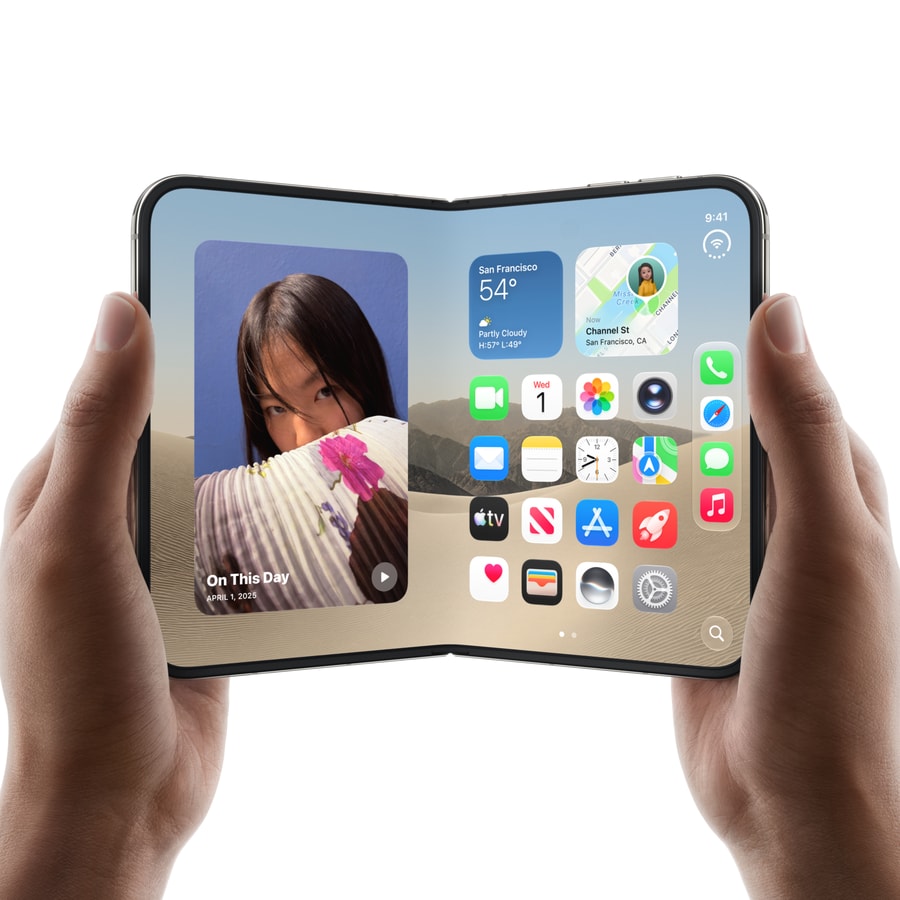
Apple has entered the foldable phone category with the announcement of iPhone Duo, a dual-display device the company is calling the most significant change to iPhone since the original 2007 model. The launch marks Apple’s answer to a foldable market that competitors have occupied for several years, and it arrives with the kind of engineering detail that has become an Apple hallmark: a custom hinge, a dedicated chip variant, and software built specifically around the fold.
A Phone That Becomes a Tablet
iPhone Duo runs two displays. The outer screen measures 5.4 inches, covering roughly 90% of the screen area found on the iPhone 18 Pro, so the device functions as a normal, compact phone when closed. Opened flat, the inner display expands to 7.6 inches — about 50% larger than the iPhone 18 Pro Max screen — turning the phone into a tablet-sized canvas for browsing, documents, and multitasking.
The hinge mechanism, which Apple says required more than 100 individual components to perfect, is built for durability as much as feel. The company is targeting a crease-free, glass-smooth inner display, a detail that has been a persistent weak point for foldables from other manufacturers. The chassis is constructed from Grade 5 titanium, and the device carries an IP68 water and dust resistance rating — a first for a folding phone at this level of durability.
Power and Cameras Built for the Fold
Driving the device is Apple’s new A20 Pro chip, paired with what the company describes as an advanced thermal management system and a dual-battery architecture split across both halves of the phone. Battery life is rated at up to 31 hours of video playback using the inner display, rising to 44 hours when relying on the outer display alone, with roughly 24 hours expected under mixed daily use.
On the camera side, iPhone Duo carries a 48MP Fusion Main camera with 2x optical zoom and a 48MP Ultra Wide lens, alongside a Center Stage front camera. Apple has built new software features around the folding form factor itself, including Smart Take, which is designed to optimise shots using both displays, and Duo Preview, which lets a subject see themselves framed on the outer screen before a photo is taken — useful for group shots taken by the phone’s owner.
Software Designed Around Two Screens
iPhone Duo ships with iOS 27, which includes a redesigned interface built to take advantage of the larger inner display. The headline addition is Split View multitasking, allowing two apps to run side by side on the unfolded screen — a first for iPhone software. Siri’s AI integration has also been extended to work across both display states, adjusting its interface depending on whether the phone is open or closed.
Pricing and Availability
iPhone Duo starts at $1,999 for the 256GB model. Apple is offering financing from $83.29 a month, and a leasing option through Apple Upgrade starting at $57.99 a month, positioning the device as a premium tier above the standard iPhone lineup rather than a replacement for it.
Pre-orders open on October 16, 2026, with the device reaching shelves in more than 70 countries on October 23, 2026 — a rollout schedule in line with Apple’s usual flagship launch pattern, suggesting the company is treating iPhone Duo as a mainstream product rather than a limited experimental release.
Why It Matters
Apple CEO-adjacent leadership framed the launch in sweeping terms. “iPhone Duo is the most transformational change to iPhone since the original,” said John Ternus, Apple’s hardware engineering chief, in the company’s announcement. That is a bold claim for a hardware category that has, so far, struggled to move beyond niche adoption industry-wide — but Apple’s entry, backed by its supply chain scale and software ecosystem, is likely to put real pressure on the category to mature.
For businesses and professionals, the appeal lies less in novelty and more in workflow: a single device that replaces the need to carry both a phone and a small tablet, with full access to iOS productivity tools like Split View. Whether that proves compelling enough to justify the price tag will become clearer once the device is in reviewers’ and early adopters’ hands after the October 23 launch.