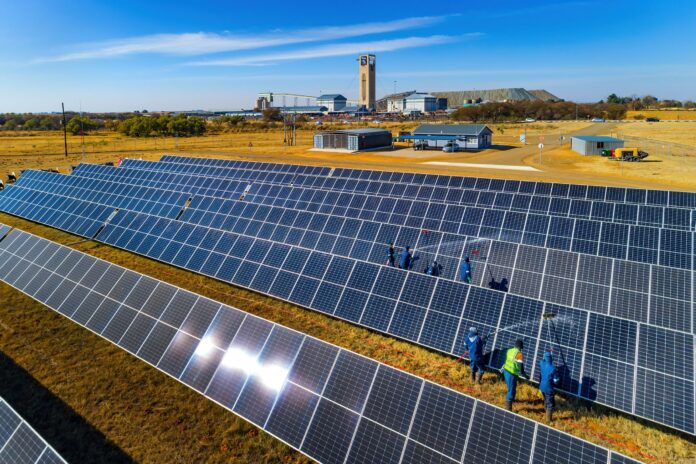

South Africa’s deep-level gold mines have long been defined by two things: extraordinary ore grades and extraordinary energy demands. Harmony Gold’s latest operational update, covering the first quarter of its 2026 financial year, shows how the company is tackling the second challenge head-on — with a 100MW solar plant at its Moab Khotsong operation in North West province standing out as one of the most significant infrastructure investments currently underway in the local gold sector.
Moab Khotsong, acquired by Harmony from AngloGold Ashanti in 2018, is among the youngest of the group’s high-grade, deep-level South African assets. It draws ore from the Vaal Reef through three vertical shaft systems feeding the Noligwa gold plant, and has in recent years also become a meaningful uranium producer as a by-product of gold extraction. The mine’s high-grade ore body has made it a priority for continued capital investment, including life-of-mine extension work that Harmony says will keep the operation productive well into the future.
The solar project is part of a broader energy resilience strategy that has become increasingly important across South Africa’s mining industry, following years of grid instability linked to load-shedding at state utility Eskom. By generating a significant share of its own power, Harmony aims to reduce both its exposure to grid disruptions and its long-term energy costs, while also advancing toward its stated target of net carbon-zero operations by 2045. Construction of the Moab Khotsong solar facility remains on track for completion by the end of calendar year 2026, according to the company’s latest guidance.
The solar build isn’t Harmony’s only infrastructure milestone this year. In July 2025, the company commissioned a new reverse osmosis water treatment plant at its Tau Tona operation, adding 10 megalitres per day of feed capacity — a project aimed at improving water management and supporting the mine’s long-term operational sustainability. Water treatment and recycling have become a growing area of investment across the South African mining sector, both for environmental compliance and for reducing dependence on increasingly strained municipal water infrastructure.
Financially, the picture for the quarter reflects a company leaning heavily into its highest-quality assets. Group capital expenditure rose 31% year-on-year to R2.87 billion (roughly US$163 million), a jump the company attributes primarily to life-of-mine extension projects at three of its flagship operations: Mponeng, Moab Khotsong, and Hidden Valley in Papua New Guinea. Production at Moab Khotsong itself declined by 20% year-on-year during the quarter, which Harmony attributes to challenging ground conditions and fluctuating face grades as mining moves through the “middle mine” section of the operation as planned — though production did tick up 6% quarter-on-quarter.
Beyond its core underground gold operations, Harmony continues to build out a growing international copper footprint, a strategic shift the company frames as complementary to its gold-first approach rather than a departure from it. The integration of the CSA copper mine and continued progress on the Eva Copper project in Australia are both expected to help offset an anticipated production gap at Moab Khotsong as that operation matures, while also diversifying Harmony’s revenue base and improving margins over the medium term. Permitting for the larger Wafi-Golpu copper-gold project in Papua New Guinea — a joint venture the company considers a Tier 1 asset — also continues to progress.
Safety remains an area the company is candid about needing further improvement. Harmony’s group lost-time injury frequency rate has fluctuated in recent reporting periods, and the company has publicly acknowledged the loss of colleagues at Moab Khotsong in incidents over the past two years, expressing its commitment to a “zero harm” goal it says it has not yet achieved. The Moab Khotsong operation specifically is described by the company as undergoing “a significant transformation aimed at fostering a proactive safety culture” — a signal that safety performance, not just production and energy resilience, remains a central pillar of the mine’s ongoing development.
Taken together, the developments at Moab Khotsong illustrate a broader pattern playing out across South Africa’s established gold belt: ageing but still highly productive deep-level mines investing heavily in renewable energy, water infrastructure, and safety systems to extend their operational life, even as some production volumes soften in the short term. For a company built on more than 60 years of South African gold mining history, the pivot toward on-site renewable generation marks one of the more visible signs of how the industry’s operating model is evolving.